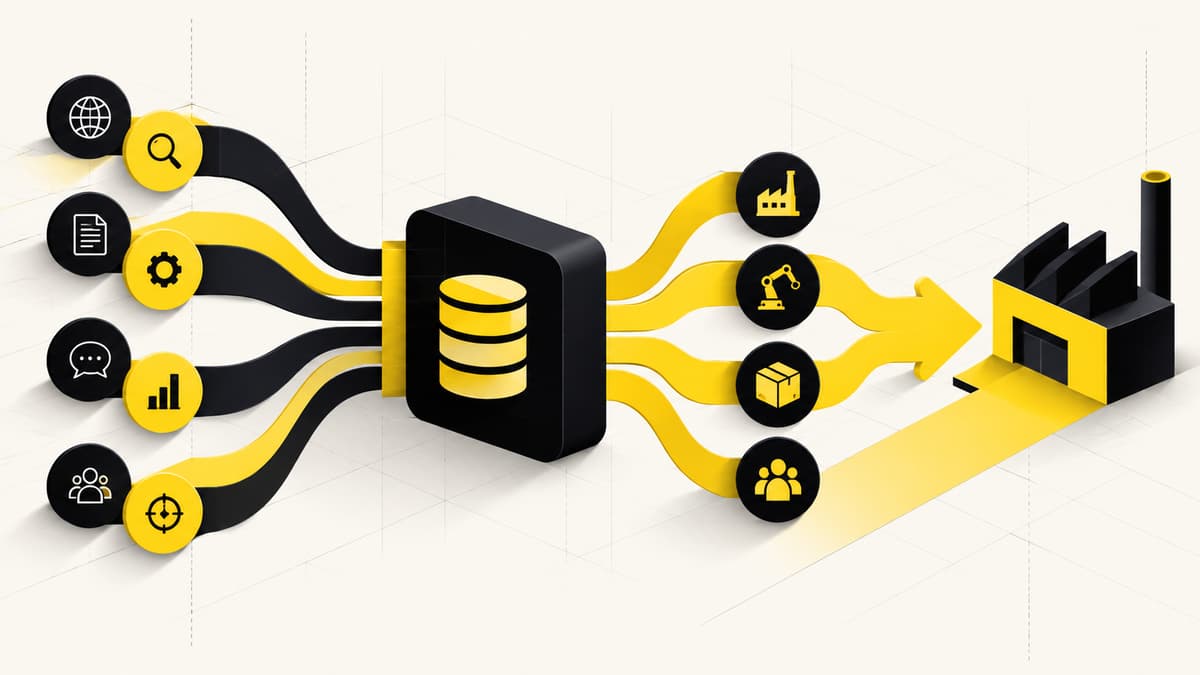
Asset Underutilization in Manufacturing: Why Idle Capacity is a Demand Alignment Problem
Part of Strategies for Improving CRM Adoption for Industrial Sales Teams in B2B Manufacturing · The Definitive Guide to Marketing and Sales Alignment in Manufacturing: Synchronizing Lead Quality for Industrial B2B Growth

Reducing asset underutilization in manufacturing requires aligning production capacity with market demand by fixing the handoff between marketing and sales. When sales teams lack the specific, stage-appropriate assets needed to close deals, lead conversion slows, leaving expensive machinery and labor idle despite existing market interest.
Why does asset underutilization happen in manufacturing plants?
Asset underutilization often occurs because of a disconnect between the assets marketing creates and the tools sales actually uses. When high-value content is hard to find or poorly tailored for the closing stage, sales reps rely on outdated materials, leading to inconsistent messaging and slower closing rates.
In many industrial environments, the problem is not a lack of machinery or skill, but a failure in content distribution. Marketing produces comprehensive guides, but if these aren't mapped to the buyer's journey, the sales team cannot effectively move a prospect from investigation to a signed contract. This creates a gap where capacity exists, but the pipeline cannot fill it fast enough.
To resolve this, leaders must solve the content-sales gap for high-value accounts, ensuring that the value proposition is reinforced at every touchpoint of the buying cycle.
How do buyers research manufacturing solutions today?
Modern B2B buyers use AI systems like Google, ChatGPT, and Gemini to research problems, investigate solutions, and compare alternatives long before they ever contact a sales representative. They ask AI what matters and who they should consider, forming a preliminary opinion based on the digital evidence available.
- Problem Search: Customers start by searching for the specific operational pain they are experiencing.
- AI Consultation: They use AI to analyze which companies are trusted and which solutions actually work.
- Independent Validation: Buyers compare alternatives and form opinions based on perceived value and familiarity.
- Sales Contact: By the time they contact sales, they are no longer strangers; they are informed prospects with a set of expectations.
Companies that shape this early buying conversation experience more trust and less need for aggressive convincing during the sales call. By the time the lead reaches the rep, the perceived value is already established, which reduces the pressure to compete solely on price and allows for more room for margin.
What is the impact of shaping the buying conversation early?
Shaping the conversation early increases perceived value and trust, meaning sales reps spend less time explaining basic concepts and more time finalizing the deal. This efficiency accelerates the pipeline, directly contributing to reducing asset underutilization in manufacturing by filling production slots faster.
| Criteria | AEOmachine | Traditional Methods |
|---|---|---|
| Buyer Perception | Familiarity and trust established via AI and research before first contact. | Stranger status; heavy reliance on sales reps to build trust from scratch. |
| Sales Effort | Less explaining and convincing; focused on closing. | High effort spent on education and overcoming basic objections. |
| Pricing Power | Higher perceived value leads to more room for margin. | Frequent price competition due to lack of differentiated perceived value. |
When a company is already part of the opinion the buyer forms during the AI research phase, the sales team becomes part of the intelligence rather than just a vendor. This shift is critical for those looking to fix the handoff between marketing and sales to ensure no lead is lost due to friction.
How can sales teams better utilize marketing assets?
Sales teams utilize assets more effectively when those assets are built around what the company already knows and are easily discoverable at the exact moment the buyer asks a specific question. The goal is to move away from generic decks toward a system that matches the buyer's current stage of investigation.
To achieve this, companies should focus on:
- Intelligence Integration: Using sales feedback to learn from actual sales interactions to refine marketing assets.
- Stage-Specific Tooling: Creating content specifically for the 'comparison' and 'closing' stages, rather than just top-of-funnel awareness.
- Aggressive Technology Use: Leveraging AI to research, analyze, and improve how knowledge is connected to the solutions being sold.
Implementing a structured approach to structure the MQL to SQL process ensures that the transition from a curious researcher to a qualified lead is seamless and supported by the right evidence.
What connects here
For those ready to implement these changes, The Definitive Guide to Marketing and Sales Alignment in Manufacturing provides the full operational framework.
To understand the underlying causes of friction, explore why sales rejects marketing leads in manufacturing to ensure your data alignment is sound.
For a deeper look at the operational side of lead management, review how to improve lead handoff in manufacturing to bridge the educational gap between teams.
Finally, ensure your infrastructure supports these goals by reviewing strategies for improving CRM adoption for your sales force.
What reaches your sales team?
Qualified demand or activity that only looks good in a dashboard?
Find outFrequently Asked Questions
How can we reduce asset underutilization in manufacturing plants?
Reduce underutilization by aligning marketing assets with the sales closing stage and shaping the buyer's early AI-driven research. This increases lead velocity and perceived value, filling idle production capacity more quickly by reducing the time spent convincing prospects.
Why do sales reps ignore marketing materials?
Reps often ignore materials if they are too hard to find or not tailored for the specific stage of the closing process, leading them to create their own outdated versions.
How does AI influence the B2B manufacturing buying process?
Buyers use AI to research problems, investigate potential solutions, and compare alternatives, forming an opinion on trust and value before they ever contact a company.
What is the benefit of shaping the buying conversation early?
Companies that shape the conversation early experience more trust, more perceived value, less competition on price, and a shorter sales cycle with less explaining required.
How can a company become a 'preferred' choice in AI recommendations?
By ensuring their unique knowledge and solutions are discoverable and connected in a way that AI systems can retrieve when buyers ask what works and who to trust.