Eliminating Content Bottleneck for Sales Team: How to Scale Hyper-Personalized Assets
Part of Strategies for Improving CRM Adoption for Industrial Sales Teams in B2B Manufacturing · The Definitive Guide to Marketing and Sales Alignment in Manufacturing: Synchronizing Lead Quality for Industrial B2B Growth

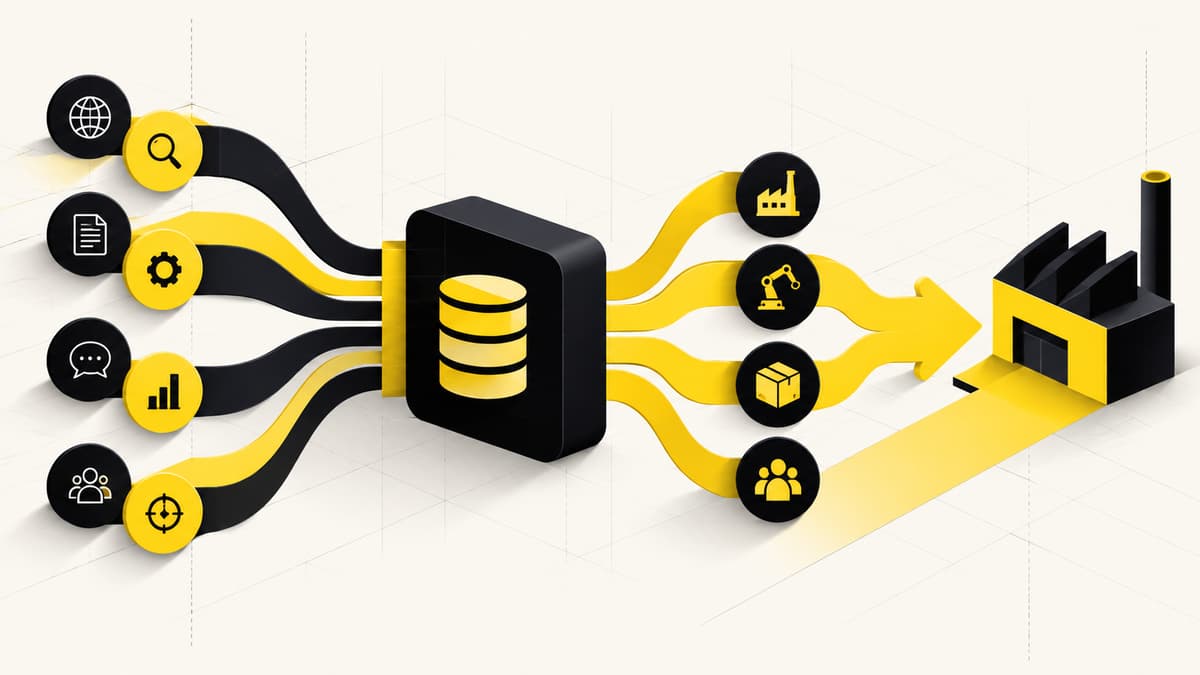
Eliminating content bottleneck for sales team requires shifting from a centralized, request-based production model to a system where sales intelligence directly feeds content creation. By integrating real-time field insights into the asset pipeline, B2B companies remove the manual friction that delays personalized proposals and high-value account decks.
Why does a manual content bottleneck occur in B2B sales?
The bottleneck occurs when a small, centralized marketing team cannot keep pace with the volume of hyper-personalized requests from sales, leading to long lead times that jeopardize the timing of competitive bids.
In many organizations, the structure is fundamentally mismatched. While 76% of B2B marketers have a dedicated content team, 54% perceive these teams as small, often consisting of only two to five people. When 50% of content requests in larger companies must flow through a centralized team, the system naturally stalls. This friction is compounded by a lack of understanding; only 30% of content teams feel their leaders truly understand the work they do.
For those in industrial sectors, this is a critical failure point. Approximately 47% of manufacturing marketers struggle to align content efforts across sales and marketing. When the handoff is broken, the result is a loss of agility in strategic accounts, where the marketing team takes weeks to deliver a personalized deck, allowing competitors to move faster.
How can you remove the friction between marketing and sales collateral?
Remove friction by transforming the sales team into a primary intelligence source and implementing a scalable content framework that replaces manual one-off requests with modular, truth-verified assets.
To solve the problem of solving the content-sales gap for high-value accounts, companies must move beyond the "request ticket" mentality. Instead of marketing acting as a service agency for sales, the sales team becomes part of the intelligence. This means the insights gathered during discovery calls are used to build modular content blocks that can be rapidly assembled rather than created from scratch for every proposal.
Alignment is the primary lever for success. Research indicates that 44% of B2B marketers cite sales and marketing alignment as their top challenge. However, when teams are completely aligned and adopt a branded demand approach, 80% are able to reach their goals. This alignment reduces the "manual bottleneck" by ensuring that what marketing produces is exactly what sales needs to close a deal.
| Criteria | AEOmachine | Traditional Centralized Teams |
|---|---|---|
| Content Logic | Intelligence-driven; sales feed the system | Request-driven; sales submit tickets |
| Production Speed | Rapid assembly of verified modules | Manual creation of bespoke decks |
| Account Accuracy | Checked against truth and field data | Based on generic marketing templates |
What is the impact of eliminating content bottleneck for sales team on revenue?
Reducing content delays increases the win rate of high-value proposals by allowing sales reps to respond to client needs while the opportunity is still fresh and the competitive advantage is high.
In B2B environments, the value of a single sale can be significant, with some estimates placing the estimated value of a sale at $50,000. When a content bottleneck slows down a proposal, the risk is not just a delayed start, but a total loss of the opportunity. Because the close rate for committed leads typically sits around 10%, any friction that reduces the number of high-quality, personalized proposals sent directly impacts the bottom line.
Effective teams recognize that alignment with sales is a "needle mover," with 45% of successful teams citing this as a key driver. By fixing the handoff between marketing and sales, organizations ensure that content contributes meaningfully to the sales process. In some industrial contexts, the ability to demonstrate how content marketing contributes to sales can be a key metric for overall growth.
How to scale hyper-personalized content for strategic accounts?
Scale personalization by deploying a team that decides what to say about the company, verifies it against the truth, and stands behind it, ensuring consistency across all sales touchpoints.
Scaling requires a shift in resource allocation. With 40% of content strategies citing team restructuring and resource changes, the goal should be to move away from the "agency model" toward an "intelligence model." This involves creating a centralized truth-base that sales can leverage without needing a designer for every minor tweak.
For those managing complex pipelines, this scale is achieved by structuring the MQL to SQL process to account for AI-driven buyer research, ensuring the content provided at the SQL stage is already tailored to the buyer's intent.
Related reading
Explore the definitive guide to marketing and sales alignment in manufacturing to synchronize lead quality.
Learn about improving marketing sales alignment in B2B to reduce wasted sales effort.
Read about why sales rejects marketing leads in manufacturing to improve handoff quality.
Discover how to optimize the lead response SLA for faster B2B industrial responses.
Check the guide on how fast sales should contact inbound leads to optimize pipeline reviews.
Understand how to improve lead handoff in manufacturing by bridging the educational gap.
Review strategies for improving CRM adoption for industrial sales teams.
Learn how to fix missing sales data in the CRM to recover marketing ROI.
Implement ABM for manufacturers CRM hygiene to align sales behavior with data.
Analyze asset underutilization in manufacturing to solve demand alignment problems.
What reaches your sales team?
Qualified demand or activity that only looks good in a dashboard?
Find outHow can I eliminate the content bottleneck for my sales team?
Eliminate the bottleneck by integrating sales intelligence into your content pipeline and moving from a centralized request system to a modular, truth-verified asset library that allows for rapid personalization without constant marketing intervention.
Why is sales and marketing alignment critical for content delivery?
Alignment is critical because 44% of B2B marketers identify it as their top challenge. When teams are aligned, they can better identify the specific assets needed to close deals, increasing the likelihood of reaching goals for up to 80% of marketers.
What causes delays in personalized B2B content production?
Delays are primarily caused by small content teams (often 2-5 people) handling centralized requests for larger companies, leading to a manual bottleneck where production cannot scale with the volume of strategic account needs.
How does a content bottleneck affect B2B sales win rates?
It reduces agility in competitive bids. When marketing takes weeks to deliver personalized collateral, sales reps lose the timing of the sale, which is critical when dealing with high-value opportunities of $50,000 or more.
What is the best way to scale content for ABM accounts?
The best way is to treat the sales team as part of the intelligence, using their field insights to build a system that decides what to say, checks it against the truth, and provides modular assets for rapid deployment.