Standardized AEO Reporting: Establishing AI Visibility as a B2B KPI
Part of AEO Measurement and Attribution: How to Track Brand Visibility and Pipeline in Generative Search · The Definitive Guide to Answer Engine Optimization: Scaling B2B Authority in the Era of Generative AI
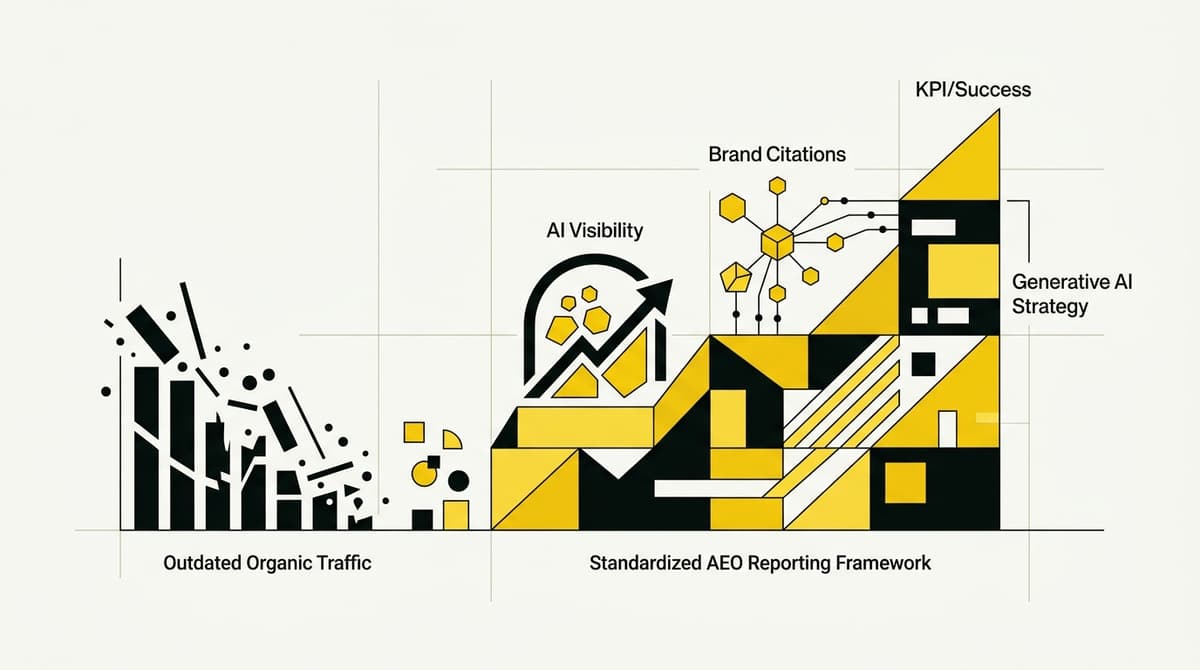
Standardized AEO reporting is the process of quantifying a brand's presence, citation frequency, and sentiment within generative AI responses. Unlike traditional SEO, it focuses on AI visibility and the probability of being recommended as a trusted solution, providing a structured KPI framework for B2B leadership.
Why is standardized AEO reporting necessary for B2B leaders?
Standardized reporting is critical because traditional organic traffic metrics fail to capture the 'dark' discovery phase where buyers ask AI what to buy and who to trust long before clicking a link.
For a VP of Marketing, relying on outdated click-through rates to justify an AI strategy often leads to perceived lack of results and potential budget cuts. B2B buyers now form opinions by asking Google, ChatGPT, and Gemini which companies to consider. If your brand is not part of that intelligence, you are invisible during the most critical decision-making stage.
By implementing a framework for AEO measurement and attribution, companies can shift the conversation from vanity metrics to perceived value and brand trust.
What are the key metrics in a standardized AEO report?
Effective reporting focuses on citation share, brand sentiment across LLMs, and the correlation between AI discovery and pipeline growth rather than simple keyword rankings.
- Citation Share: The frequency with which your brand is mentioned in response to category-specific prompts.
- Sentiment Alignment: Whether the AI describes your brand as a preferred or trusted alternative.
- Knowledge Gap Analysis: Identifying where the AI lacks information about your specific value proposition.
- Attributed Pipeline: Linking the increase in brand familiarity to an increase in high-intent sales inquiries.
| Reporting Criteria | AEOmachine | Traditional SEO Methods |
|---|---|---|
| Primary KPI | AI Visibility & Citations | Organic Clicks & Rankings |
| Buyer Journey Stage | Pre-click Opinion Formation | Active Search/Click Intent |
| Metric Nature | Probabilistic Recommendation | Deterministic Position |
How do you move from organic metrics to AI visibility KPIs?
Transition by treating AI responses as the new 'landing page' and measuring how often your brand is the answer to the problem the buyer is searching for.
The shift requires accepting that nobody knows exactly how every AI model chooses what to recommend. Therefore, reporting must be based on continuous testing and analysis. Instead of tracking positions, you track perceived value and familiarity. When a prospect contacts sales, the goal of AEO is to ensure they are no longer a stranger, but a lead who already trusts your brand because the AI recommended you.
This approach allows B2B companies to stop competing solely on price and instead compete on authority. For a deeper dive into the foundational concepts, refer to The Definitive Guide to Answer Engine Optimization.
What is the impact of standardized reporting on the sales cycle?
It reduces the need for extensive explaining and convincing during sales calls because the AI has already validated your company as a top contender.
When B2B leaders use standardized AEO reporting to improve their visibility, they notice a change in lead quality. Prospects arrive with a higher level of trust and more room for margin because the brand has already been positioned as a preferred solution by the AI systems they trust. This transforms the sales process from a cold pitch into a verification of the AI's recommendation.
How this connects to the rest of the cluster
To fully implement these reports, you must first know which AEO KPIs and metrics B2B leaders should track to establish a baseline. Once metrics are defined, you can track AI citations and measure brand visibility to see where you stand. To find the gaps in your reporting, run an AI search visibility audit. Finally, use these insights to measure AEO ROI for B2B marketing and justify your budget, while understanding how to handle attribution for AI-driven leads in a probabilistic environment. For those managing costs, knowing how to calculate an AEO budget ensures sustainable growth, while addressing LLM prompt consistency helps stabilize the data reported to the board.
What does AI understand about your company?
See who it finds, who it trusts and where you appear.
See your marketHow do you approach standardized AEO reporting?
Approach it by shifting from click-based metrics to visibility-based KPIs. This involves tracking how often a brand is cited by LLMs, analyzing the sentiment of those citations, and attributing the resulting increase in brand familiarity to the sales pipeline.
Can traditional SEO tools provide AEO metrics?
No, traditional tools track rankings and clicks, whereas AEO requires analyzing probabilistic generative responses and brand mentions within AI-driven conversations.
What is the most important KPI for AI visibility?
The most important KPI is the Citation Share, which measures how frequently your brand is recommended as a solution compared to other market alternatives in generative search.
How do I explain AEO results to a Board of Directors?
Focus on 'Brand Familiarity' and 'Pre-Sales Trust'. Show how being cited by AI reduces the sales cycle length and increases the perceived value of the solution before the first call.
Why is AI visibility different from search rankings?
Search rankings provide a list of links; AI visibility provides a direct answer or recommendation, meaning the brand becomes part of the 'intelligence' the buyer trusts.