AEO Measurement and Attribution: How to Track Brand Visibility and Pipeline in Generative Search

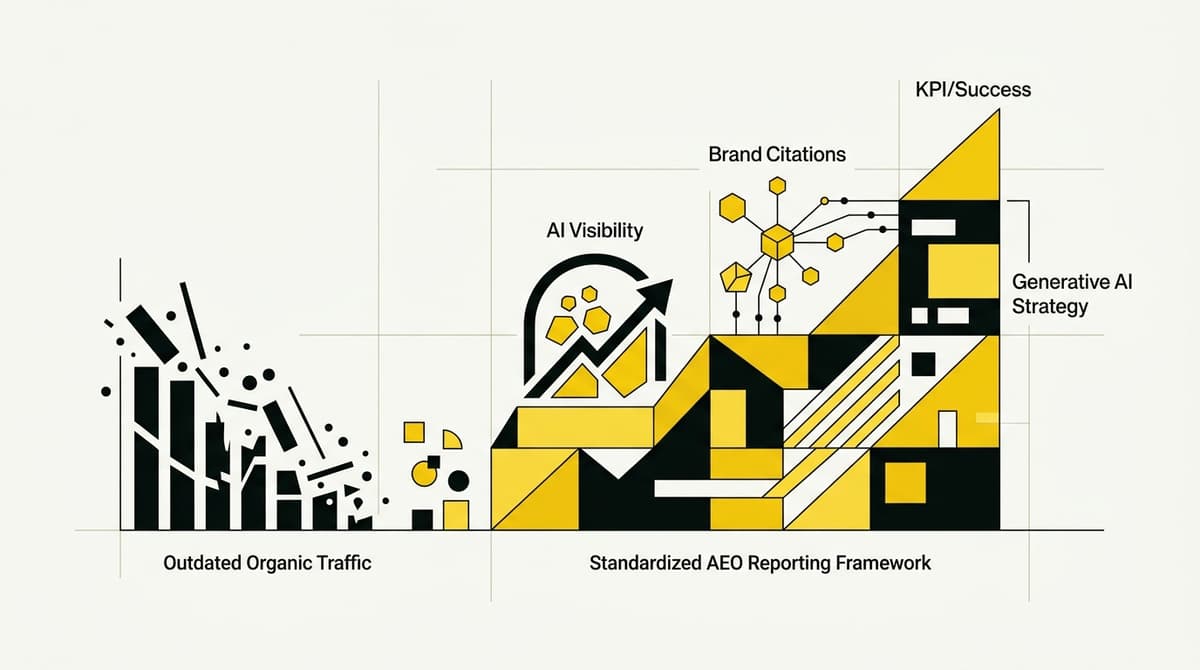
AEO measurement and attribution is the process of quantifying a brand's visibility within AI-generated answers and probabilistically linking those citations to B2B pipeline outcomes. Unlike traditional SEO, it relies on repeated sampling of LLM responses and brand association tracking rather than simple click-through rates.
What this guide covers
This guide addresses the critical lack of AEO KPIs and metrics for B2B leaders, where marketing teams struggle to find reliable ways to measure their share of voice across diverse AI search platforms. Currently, many SEO managers fall into the failure mode of manually typing prompts into ChatGPT or Perplexity and recording results in unreliable spreadsheets. This leads to wasted engineering and marketing hours spent on unquantifiable tests. We solve this by establishing a professional framework to baseline performance and monitor brand visibility in LLMs over time.
Why it matters for SEO Managers
For the modern SEO Manager, the shift toward generative AI means that traditional traffic metrics no longer tell the whole story. B2B buyers increasingly ask AI assistants for vendor shortlists and comparisons before they ever visit a website or contact sales. If your brand is not cited in these answers, you are invisible during the most critical phase of the buyer's journey. Establishing a system for AEO measurement and attribution allows you to prove the value of your content strategy to leadership and ensures you are not losing market share to competitors who are better optimized for AI discovery.
| Measurement Criteria | AEOmachine | Traditional SEO Methods |
|---|---|---|
| Visibility Tracking | Systematic AI citation sampling and brand association monitoring | Keyword rankings and organic click-through rates (CTR) |
| Attribution Model | Probabilistic brand association and pipeline influence | Deterministic last-click or first-click attribution |
| Data Source | Live LLM retrieval and training data patterns | Search engine results pages (SERPs) and index logs |
| Success Metric | Share of Voice in generative answers and AI recommendations | Position 1-10 rankings and total organic sessions |
To stop the guesswork and start scaling your visibility, explore AEOmachine's professional AEO solutions to automate your brand tracking.
How to solve it
Establish an AI citation baseline
Measuring visibility requires moving from ad-hoc prompts to a structured audit. You must identify the core technical questions your market asks and record which brands AI systems currently cite as authoritative sources. Because AI answers vary between sessions and phrasings, a single prompt is not a metric; you need repeated sampling over time to find the statistical mean of your visibility. This baseline tells you exactly where you stand today and which competitors are currently owning the canonical answers in your niche.
To execute this professionally, you should learn how to run an AI search visibility audit to identify the gaps in your public knowledge base that prevent citations.
Implement repeated sampling for visibility tracking
AI systems like ChatGPT and Gemini are non-deterministic, meaning they can provide different answers to the same question in different sessions. To accurately track your share of voice, you must implement a sampling cadence where key queries are tested across multiple LLMs and multiple iterations. This process transforms anecdotal evidence into a reliable dataset. By recording the frequency of your brand's mention relative to the total number of answers, you create a "Generative Share of Voice" (gSOV) metric that is defensible to stakeholders.
For a detailed technical framework on this process, see our guide on how to track AI citations and measure brand visibility in generative search.
Shift to probabilistic attribution models
The biggest challenge in AEO measurement and attribution is that a citation in an AI answer cannot be traced as a direct click in the way a traditional link can. Many users receive the answer, form an opinion, and then navigate directly to the brand's website or contact sales. Therefore, attribution must become probabilistic. You track the correlation between increased AI visibility and the rise in direct traffic or "branded search" volume. When a brand is consistently mentioned in AI recommendations, it enters the buyer's consideration earlier, reducing the need for expensive convincing during the sales call.
You can master this transition by learning how to handle attribution for AI-driven leads in B2B environments.
Quantify brand association and sentiment
Beyond simple citations, you must measure brand association. This involves asking AI systems about a problem category (e.g., "What are the best industrial tolerance software tools?") and analyzing whether your brand is mentioned as a top recommendation. AI assistant recommendations emerge from patterns in training data and live retrieved sources. If the AI associates your brand with "reliability" or "innovation" without you being explicitly prompted, you have achieved a high level of semantic authority. This association creates a perception of value that allows for higher margins and less competition on price.
To protect these associations and ensure they remain positive, read about managing brand association in generative AI.
Connect AEO visibility to pipeline ROI
To justify investment, you must link AI visibility to business outcomes. This means moving from vanity metrics (like "we were mentioned once") to ROI metrics. Track the lead velocity and the quality of leads coming from the "investigation" and "comparison" stages of the journey. When buyers are pre-educated by AI answers that cite your brand, they experience more trust and require less explaining from the sales team. This efficiency gain—measured in reduced sales cycle length and increased win rates—is the true ROI of an AEO strategy.
Discover the financial frameworks for this in our deep dive on measuring AEO ROI for B2B marketing.
Monitor the "Zero-Click" impact on lead flow
AI Overviews and LLMs can reduce clicks to websites because the answer appears directly on the results page; see reducing AI Overviews traffic impact through AEO for the mechanics. A critical part of AEO measurement and attribution is understanding the delta between lost informational traffic and gained high-intent pipeline. While your total sessions might drop, your conversion rate often increases because the traffic that does reach your site has already been vetted by an AI agent. Measuring this shift requires a holistic view of the funnel, focusing on lead quality over raw traffic volume.
Learn the specific movements to protect AI search traffic and B2B pipeline when organic clicks decrease.
Further context
Understanding AEO measurement and attribution is only possible once you understand the underlying mechanics of how AI engines choose and cite sources and how to build a technical foundation for AI visibility, as this determines what you are actually measuring.
Once you can measure your current status, you can apply the principles of managing brand association and risk to ensure the AI is attributing the right values to your brand.
These metrics then feed directly into your AEO strategy and economics, allowing you to budget based on visibility gains rather than arbitrary traffic goals.
Ultimately, this measurement framework allows you to protect your B2B pipeline by ensuring your expertise remains visible even as the interface of search changes.
For a comprehensive overview of how these pieces fit together, return to our pillar page on how AEO builds around existing company knowledge.
What does AI understand about your company?
See who it finds, who it trusts and where you appear.
See your marketHow do you measure AI search visibility and attribute pipeline to it?
You measure visibility through repeated sampling of LLM responses for target market questions to calculate your Generative Share of Voice (gSOV). Attribution is handled probabilistically by correlating these visibility spikes with increases in branded search and direct traffic to high-intent pipeline stages.
Can I use traditional SEO tools for AEO measurement?
Traditional tools track rankings and clicks, which are insufficient for AEO. AEO requires monitoring citations within generative summaries and brand mentions in non-deterministic AI responses, requiring specialized sampling and auditing techniques rather than just keyword tracking.
What is the difference between a citation and a brand mention in AEO?
A citation is a direct reference or link to a specific source page that the AI used to generate an answer. A brand mention is when the AI recommends a company based on general patterns in its training data, regardless of whether a specific link is provided.
How often should I sample AI responses for measurement?
Because LLM models and retrieval algorithms update frequently, a monthly or quarterly sampling cadence is recommended for baseline tracking, with weekly checks for high-priority target questions during an active optimization campaign.
Why does AI visibility lead to a shorter sales cycle?
When an AI recommends your brand as a solution to a problem, the buyer arrives at the first sales contact already familiar with your value proposition. This reduces the time spent on education and trust-building, accelerating the transition from consideration to decision.
Ready to move beyond manual spreadsheets? Get started with AEOmachine today and implement a professional measurement framework for your AI visibility.
Want this applied to your company? Talk to us.