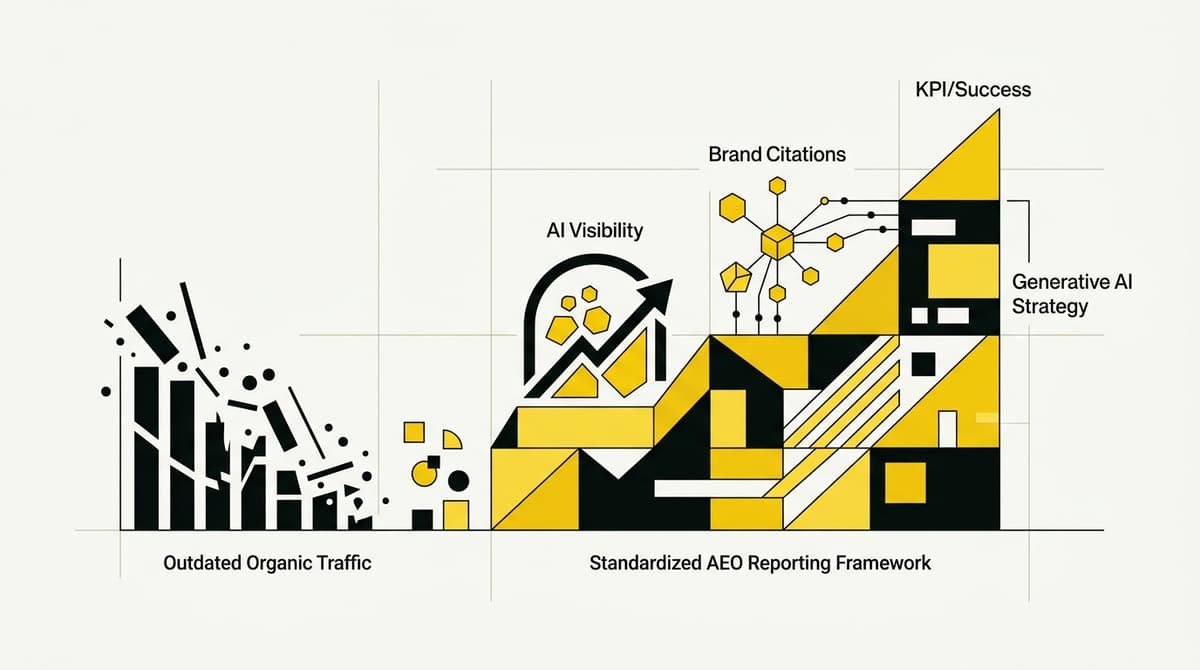
AEO Analytics and Measurement Blindspot: Why Traditional SEO Tracking Fails in Generative Search
Part of AEO Measurement and Attribution: How to Track Brand Visibility and Pipeline in Generative Search · The Definitive Guide to Answer Engine Optimization: Scaling B2B Authority in the Era of Generative AI

The AEO analytics and measurement blindspot is the inability of B2B marketers to quantify brand visibility within LLMs because traditional rank trackers cannot monitor probabilistic AI responses. This gap prevents leaders from knowing if their brand is being cited as a source in generative answers.
Why do traditional analytics create an AEO analytics and measurement blindspot?
Traditional analytics track clicks and positions on a static results page, whereas answer engines generate dynamic, conversational responses. This shift makes standard keyword rankings irrelevant, as the value shifts from a URL click to being the cited source within a generated answer.
Many B2B organizations face significant hurdles in this transition. According to the CMI B2B Content Marketing Benchmarks 2025, 41% of B2B marketers lack easy access to enterprise analytics. This lack of tooling is compounded by the nature of generative AI, where a brand may be the primary recommendation without ever appearing in a traditional top-10 blue link list.
Furthermore, the challenge is often internal. Data from CMI Manufacturing Content Marketing Benchmarks indicates that 32% of manufacturing marketers struggle with an inability to extract valuable information from their existing data, while 31% cite limited access to advanced tools as a primary challenge. When combined with the fact that 48% of these marketers lack clear KPIs, the resulting blindspot makes it nearly impossible to justify budgets for generative engine optimization.
| Measurement Criteria | AEOmachine | Traditional SEO Tools |
|---|---|---|
| Visibility Tracking | Tracks citations and mentions across LLMs | Tracks keyword positions in SERPs |
| Data Nature | Probabilistic and conversational analysis | Deterministic URL ranking |
| Reporting Focus | Share of Model and AI Brand Authority | Organic Traffic and Click-Through Rates |
How can I measure my brand's visibility across different answer engines?
Measure visibility by tracking "Share of Model"—the percentage of time your brand is cited across a set of industry-specific prompts—and monitoring citation frequency and sentiment across multiple generative AI platforms.
To move beyond the blindspot, B2B leaders must shift from tracking traffic to tracking presence. This involves using specialized methods to track AI citations and measure brand visibility in generative search, focusing on whether the AI views the brand as a trusted authority for specific queries.
Effective teams are already prioritizing this shift. The CMI B2B Content and Marketing Trends 2026 report shows that 27% of high-performing teams identify data quality and analytics capabilities as their primary "needle movers," while 40% emphasize measurement and reporting as critical drivers of success.
What metrics should be used to report AI visibility honestly?
Report visibility using a combination of citation share, brand mention frequency in AI-generated summaries, and the correlation between AI mentions and direct lead pipeline growth.
Because LLMs can be inconsistent, it is vital to address LLM prompt consistency and reliability. A brand might be cited in one session and ignored in another; therefore, reporting must be based on aggregated prompt sets rather than single queries.
To build a sustainable reporting framework, leaders should focus on standardized AEO reporting. This allows the Digital Marketing Director to present AI visibility as a B2B KPI, moving the conversation from "we think we are visible" to "we are mentioned in X% of category-defining queries." This approach helps in measuring AEO ROI by linking AI presence to the lead generation pipeline.
How does the measurement blindspot affect B2B lead generation?
The blindspot causes a discrepancy where reports show a drop in organic traffic, but the brand is actually maintaining or increasing its influence as a cited authority within AI answers, which directs high-intent users to the site.
Since 81% of marketers use analytics tools and 72% use social media analytics (CMI B2B Benchmarks 2024), the tools are present, but they are often the wrong tools for the job. When a brand is cited in an AI overview, the user may navigate directly to a product page or contact form, bypassing the traditional "organic landing page" flow. This makes it critical to understand how to handle attribution for AI-driven leads.
To solve this, companies should run an AI search visibility audit to identify where the brand is missing from the conversation and then implement Answer Engine Optimization strategies to improve eligibility for citation.
Continue with
Explore the AEO KPIs and metrics B2B leaders track to build your measurement framework.
Review AEO measurement and attribution to understand the evidence behind AI visibility tracking.
Check out the best LLM monitoring tools for tracking brand mentions in generative AI.
What does AI understand about your company?
See who it finds, who it trusts and where you appear.
See your marketHow can I measure my brand's visibility across different answer engines?
You can measure visibility by implementing a "Share of Model" tracking system, which involves querying a diverse set of industry prompts across multiple LLMs and calculating the percentage of responses that cite your brand as a recommended source or authoritative reference.
Which KPIs are most important for AEO?
The most critical KPIs include Citation Rate (how often you are cited), Sentiment of Mention (how the AI describes your brand), and Share of Model (your visibility compared to competitors in AI responses).
Can traditional Google Search Console track AI visibility?
Google Search Console can track impressions from AI Overviews if they lead to clicks, but it cannot track mentions in other LLMs or citations that do not result in a direct click, which is where the measurement blindspot occurs.
Why is attribution difficult for AI-driven leads?
Attribution is difficult because AI answer engines often act as a "dark funnel," where the user consumes the brand's value proposition within the AI interface and then enters the website via a direct search or URL, bypassing traditional referral tracking.
How often should a B2B brand audit its AI visibility?
Due to the frequent updates and training cycles of LLMs, B2B brands should conduct AI visibility audits quarterly to ensure their content remains retrievable and verifiable by the latest model versions.